
Collagen, skin and ageing: what bone broth actually does.
Collagen is the most marketed molecule in wellness. Bone broth is one of the few places it arrives as real food — with the minerals, gelatin and amino acids the body actually uses to repair skin.
7 min read

What actually changes with age
Collagen makes up the majority of the dry weight of the dermis. It is what keeps skin firm, and alongside elastin it is why young skin springs back. Production slows steadily from the mid-twenties, and the decline steepens around menopause as oestrogen falls. Sun exposure, smoking, poor sleep and high sugar intake all accelerate the breakdown.
The visible result is familiar: thinner skin, less bounce, lines that stay after the expression has gone, and slower healing. This is where bone broth earns its place — not as a quick fix, but as a steady, daily supply of the exact nutrients the body uses to repair what time takes.
Why bone broth is genuinely good for skin
Collagen you swallow is broken down in the gut into amino acids and short peptides — none of it travels intact to your face. But far from useless. Collagen is unusually rich in glycine, proline and hydroxyproline: amino acids that appear in ordinary diets in relatively small amounts, and that the body specifically needs to build new collagen. Bone broth is one of the few whole foods that delivers them in meaningful quantity, alongside the minerals, gelatin and fluid skin uses to stay hydrated and firm.
Our Pure Chicken blend carries the highest collagen protein count of anything we make — 11g of protein per 240ml, with no salt, no onion and nothing else to work around. It is the most concentrated whole-food dose of collagen-building amino acids in the range, and it blends cleanly into a morning smoothie or a warm cup.
A 36-hour slow cook is what releases that collagen into the broth at all. Shorter cooks pull flavour but leave the gelatin in the bones. A broth that sets to a firm gel when chilled is the clearest sign you are getting real, usable collagen — not just flavoured water.
Collagen you drink does not reach your face intact. It arrives as raw material — which is exactly what repair requires.
The blend for glowing skin
If your goal is visible glow, the Chicken, Lotus, Cordyceps Flower & Jujube blend is the one to reach for. Its ingredients were chosen in the Chinese tonic tradition for exactly the kind of nourishment that shows on the face.
Jujube — the red date — is rich in antioxidants, which help quieten the free-radical damage that ages skin. Lotus seed calms the nervous system and settles the kind of stress-driven inflammation that dulls complexion. Cordyceps flower rebuilds energy reserves at a cellular level, the deeper depletion that leaves skin looking tired no matter how much you sleep. Together they turn a cup of broth into something more restorative than collagen alone.
This is why the people who drink it regularly describe the same quiet changes first: skin that feels more hydrated, a steadier glow, and stronger nails. It is anecdotal rather than proven — but it is consistent.
The Vitamin C detail
Vitamin C is required for collagen synthesis — without it, the amino acids have nothing to bind into. A cup of broth alongside a diet with fruit and vegetables is a more sensible plan than broth alone.
An easy way to add it: a squeeze of fresh lemon juice into a morning cup of our Beef, Fennel, Sage & Rosemary broth. The lemon brightens the flavour and gives the body the Vitamin C it needs to turn that collagen protein into something the skin can actually use.
Why bone broth beats collagen powder
Collagen powder gives you one isolated molecule — hydrolysed peptides, stripped of everything around them. Bone broth gives you the same collagen-building amino acids, but inside real food: alongside minerals, gelatin, electrolytes and the fluid your skin uses to stay hydrated and firm. The body does not use nutrients in isolation. It uses them together, and broth is the form it already knows how to use.
- Powder is one molecule in a scoop. Broth is collagen protein, minerals, gelatin and electrolytes — a whole-food package, not an isolate.
- Broth carries no sweeteners, flavourings or fillers. Many powders add all three.
- A 36-hour broth that sets to a firm gel when chilled is the clearest sign you are getting real, usable collagen — not just a label claim.
- Broth is warm, savoury and satisfying. Powder is a scoop stirred into water you have to remember to take.
- A daily cup of broth is the habit most people are still keeping a year later. A tub of powder, less often.
If you are already taking a powder and it is working for you, there is no need to stop. But if you are choosing where to begin, broth is the better place — the same amino acids, in the form your body is built to absorb, in a routine you will actually keep.
How to use it for skin
- One 250ml cup daily, most days — skin turnover is measured in weeks, so judge it at eight to twelve weeks, not one.
- Pair with a vitamin-C-rich diet so the body can use the amino acids; a squeeze of lemon in a morning cup does it.
- Protect what you have: daily SPF does more for skin ageing than any supplement.
- Sleep and blood-sugar stability are part of the same picture — broth helps with both.
- For a savoury smoothie, blend chilled Pure Chicken with frozen mango, ginger and yoghurt.
An honest expectation
Bone broth will not reverse ageing, and anyone promising that is selling something. What it does is supply, in food form, the specific amino acids collagen is built from — consistently, and without additives. That is more than a powder can offer in isolation, and it is why broth is the one we recommend. The people who keep it going usually describe the same quiet changes first: skin that feels more hydrated, a steadier glow, and stronger nails. That is the real promise, and it is worth keeping.
Common questions
- Does bone broth help skin?
- Bone broth supplies glycine and proline, the amino acids the body uses to build new collagen, plus minerals and gelatin that help skin hold hydration and firmness. Evidence for collagen intake and skin elasticity is promising but modest, and results build over weeks rather than days.
- Which Matsu broth has the most collagen?
- Our Pure Chicken blend carries the highest collagen protein count — 11g of protein per 240ml, with no salt and no onion. It is the most concentrated whole-food dose in the range and blends cleanly into a smoothie or a warm cup.
- Is bone broth as good as collagen powder?
- Broth gives you the same collagen-building amino acids as a powder, but inside real food — alongside minerals, gelatin and electrolytes, with no sweeteners or fillers. It is the form your body is built to absorb and the habit most people actually keep. Powder is a convenient isolate; broth is the better place to begin.
- How long before I see a difference in my skin?
- Skin turnover takes weeks. Judge it at eight to twelve weeks of near-daily use, not after a few cups.
- Why add lemon to bone broth?
- Vitamin C is required for collagen synthesis, so pairing broth with a vitamin-C-rich food helps the body actually use the amino acids. A squeeze of fresh lemon in a morning cup of Beef, Fennel, Sage & Rosemary is an easy way to add it.
- Does bone broth help hair and nails too?
- Hair and nails are protein structures that draw on the same amino acid pool, and stronger nails are one of the most commonly reported changes. It is anecdotal rather than proven.
Start the routine
Recommended broths


Keep reading
More from the Journal
Gut · 7 min read
Bone broth for gut health: what the body actually needs
The gut does not ask for complicated protocols. It asks for consistent, whole-food nourishment. Bone broth is one of the simplest ways to deliver it.
Read the article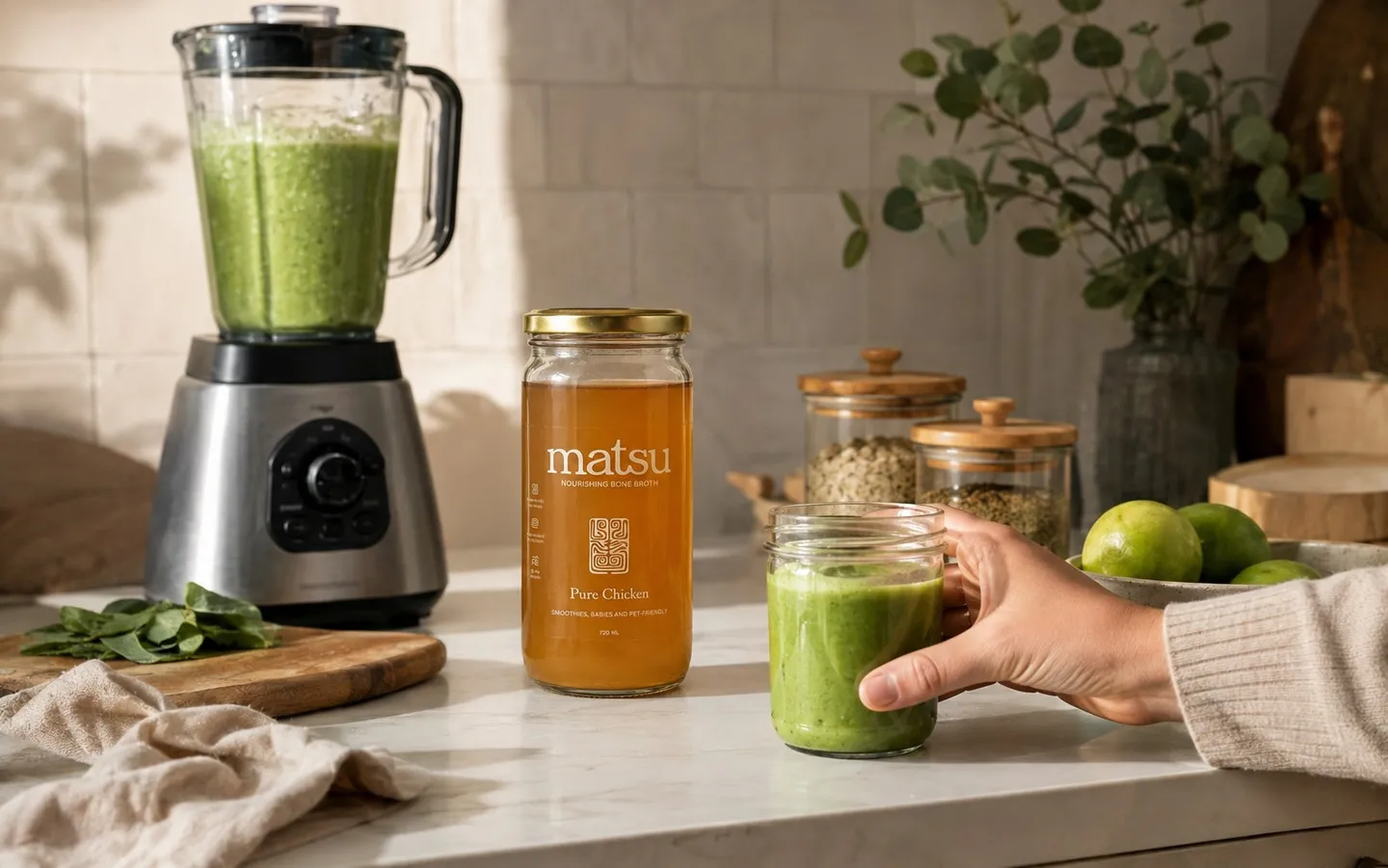
Recovery · 7 min read
Bone broth for athletes: train better, recover well
Training breaks tissue down. Recovery is where the adaptation happens — and connective tissue is the part most training plans forget to feed.
Read the article
Sleep · 6 min read
Bone broth for sleep: the restorative evening cup
Most sleep advice is about what to remove. This is about what to add — a warm cup that shapes a good night's sleep.
Read the article